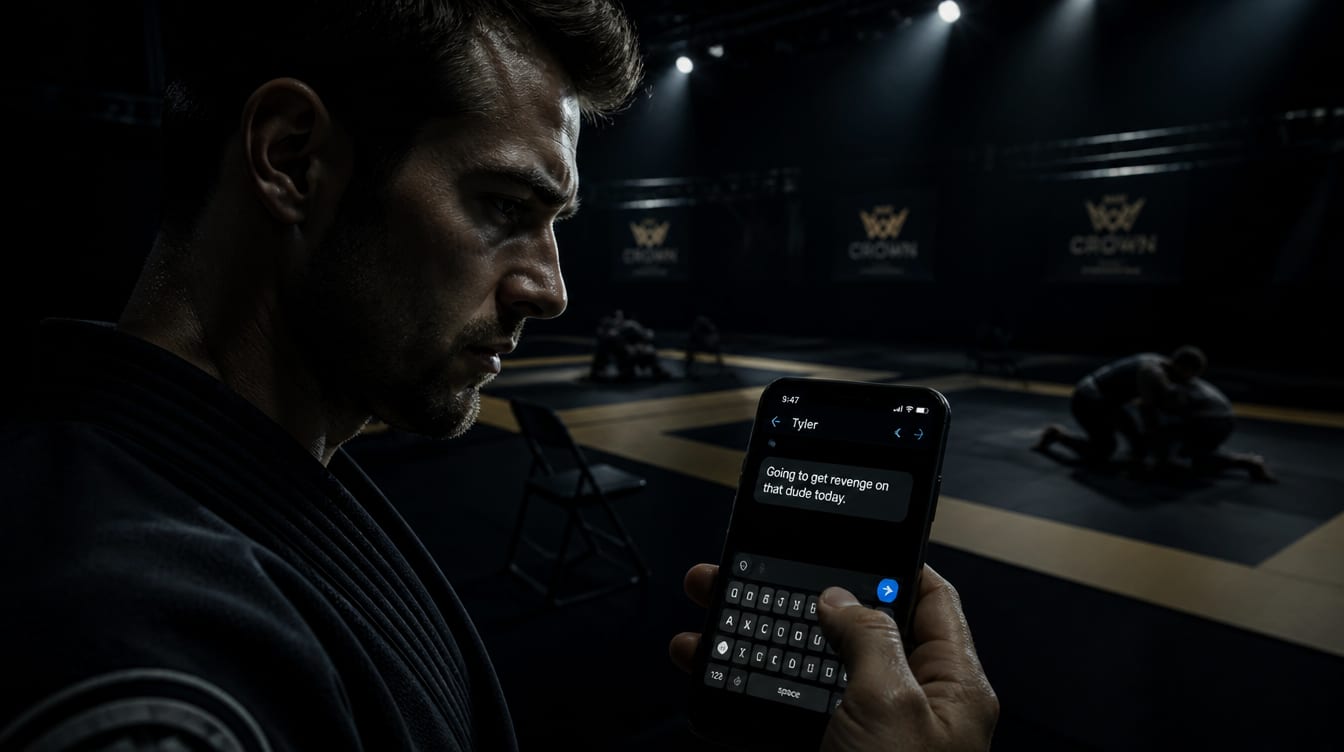
Marcus Thiel, a 34-year-old insurance adjuster and brown belt at Crown Grappling Club in Lakewood, Colorado, texted his training partner a revenge threat at 6:47 a.m. on the morning of the State Grappling Championship, held July 12 at the Arapahoe County Fairgrounds. The text read: "Going to get revenge on that dude today." He hit send. Three hours later, in his first match, Thiel tapped to an ankle lock in two minutes and forty-three seconds. This was his eighth consecutive tournament in which a pre-match revenge text had preceded a submission loss within six minutes. The pattern began in May 2025, when Thiel lost a rolling session to a black belt named Carl at an open mat facility in Boulder. The loss was unremarkable—a standard arm drag cascade into a back control tap. Eight months passed. At the next tournament in May 2026, Thiel texted: "Ready to get revenge on that ankle locker from open mat." He didn't face Carl. He faced a brown belt named Derek from Axiom Jiu-Jitsu, a rival gym thirty minutes north. Thiel tapped to a knee reap in four minutes and twelve seconds. He returned to Crown Grappling and told Jason Park, the gym's owner, "I wasn't ready." What Thiel didn't realize was that his pre-match text had been screenshotted by Trevor Okonkwo, a training partner, and forwarded to the Crown Grappling group chat with a single comment: "Revenge text ✓. Tap incoming?" Derek won the entire tournament, went 3-0, and Thiel drove home listening to a podcast about meditation. July 2025: Thiel texted "getting my revenge today" at a NAGA tournament in Aurora. He lost to a brown belt from a gym he'd never trained with. Ankle lock, three minutes and fifty seconds. The screenshot was added to Trevor's running spreadsheet. September 2025: "Time to get revenge." Berimbolo tap, five minutes and twenty seconds. March 2026: "Going to take what's mine." Heel hook tap, three minutes flat. Trevor's spreadsheet now had a second column: "Tap time (min)." The standard deviation was under two minutes. May 2026: "That dude doesn't know what he's in for." Ankle lock tap, four minutes. The Crown Grappling group chat, which had expanded to include all twelve members of the gym, now received a formal prediction the night before Thiel's tournaments. "Marcus texted a threat," Jason Park would announce. "Estimate: brown belt opponent, submission loss, 3-5 minutes." The predictions were accurate enough that Park began charging a small "prediction fee" (donated to charity) when teammates bet on the margin of victory. June 2026: "Going to make that guy regret ever seeing me." Arm drag cascade into a footlock tap, six minutes and three seconds. This was notable because it was Thiel's first loss to a non-ankle-lock submission. The spreadsheet's "Tap Method" column expanded. Now July: the eighth consecutive text, the eighth consecutive loss, all within a tight temporal window. "It's definitely superstition masquerading as preparation," said Trevor Okonkwo, the training partner who maintained the spreadsheet with the precision of a baseball statistician. "Marcus is convinced the revenge text is psychological preparation—a signal to himself that he's got skin in the game. But what it actually does is make him enter competition in a hyperanxious state. He's already defeated before the ref whistles in." Thiel's explanation was simpler and more circular. "That first guy, Carl, had me in a bad spot during open mat," he said, referring to the May 2025 black belt who had inspired the entire cycle. "I wasn't ready that day. I'm ready now." It was fourteen months later. Thiel had texted eight revenge promises, attended eight tournaments, faced eight different opponents, and lost eight times. Jason Park, owner and head instructor of Crown Grappling, stopped suggesting that Thiel abandon the ritual. "If Marcus sends a message about revenge in our group chat, I tell new students exactly what's going to happen," Park said. "He'll lose. Probably to a submission. Probably within four to six minutes. He's become a living tell—his pre-match text is more reliable than any competitor analysis I could do." Park began warning neighboring gyms: "If you face Marcus Thiel at a tournament, and he's posted about revenge, your odds of winning increase by about 40 percent." The superstition deepened in February 2026, when Thiel attempted to break the cycle. He attended a tournament without texting a revenge threat beforehand. He lost his first match by points, 8-4. Upon returning to Crown Grappling, visibly shaken, Thiel immediately texted the group chat: "I'm getting revenge on that match result at the next tournament." He competed five weeks later and tapped to an armlock in three minutes and eighteen seconds. The cycle had resumed. Thiel had now created a secondary revenge narrative to punish himself for the attempted escape. Rhonda Chen, a sports psychologist Thiel briefly consulted, offered a diagnosis: "He's got the causal arrow backwards. He believes the threat creates the mindset. What's actually happening is that his anxiety creates the threat. The threat is a symptom, not a cure. He walks into every tournament afraid, so he pre-announces it as a revenge narrative. Then the anxiety does its job." Thiel paid for one session and discontinued treatment, citing "schedule conflicts with tournaments." He has since scheduled and attended four tournaments but has reported no scheduling conflicts for therapy. The logic has now become so circular that it's difficult to interrupt. Thiel does not tape-review his matches. He does not identify technical gaps. He does not adjust opponents or competition weight classes. He texts a revenge threat, loses, and then uses that loss as evidence that he needs to text another revenge threat. Crown Grappling's spreadsheet includes a betting pool. Teammates have wagered on whether Thiel will text a revenge threat before his next scheduled tournament on September 5. Current consensus: Thiel will text the threat. Odds favor a tap within four minutes. At this point, the gym is simply waiting for the moment when Thiel's revenge texts become so reliable that other competitors begin requesting the text schedule in advance, simply to guarantee a win.
THEPORRA · PURE SATIRE Mon, Jul 27, 2026, 03:31 PM ET
Brown Belt's Revenge Text Curse
Brown belt Marcus Thiel's revenge texts have preceded eight consecutive tournament losses. His training partners are now tracking the pattern.